
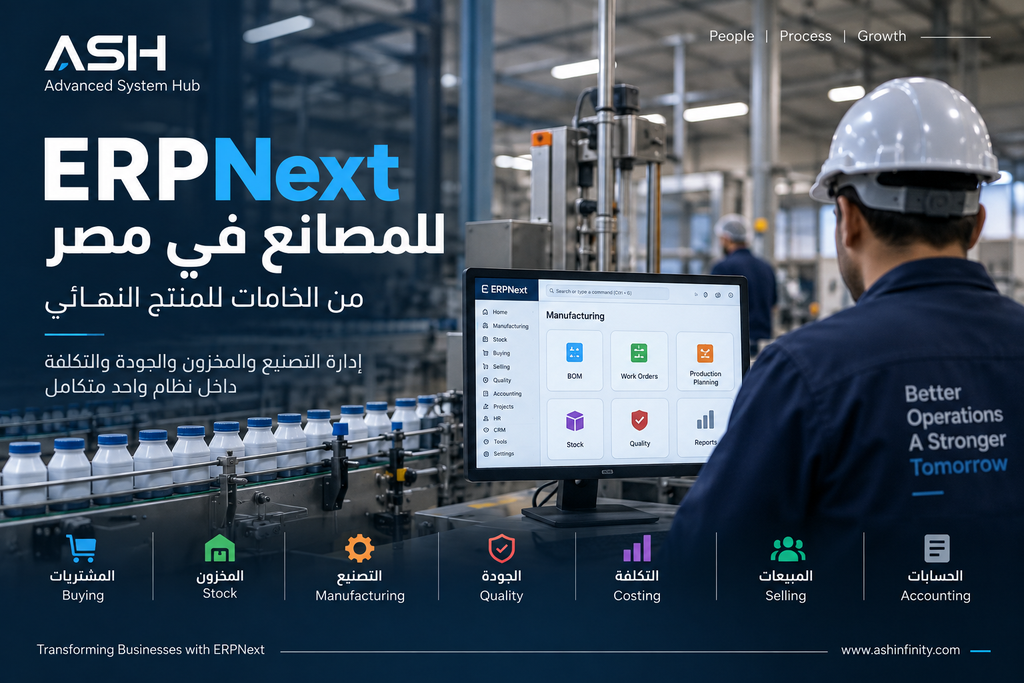
Why Does a Factory Need More Than Accounting Software?
Manufacturing operations do not begin with a sales invoice or end with calculating product cost.
The process can start with purchasing and receiving raw materials, continue through inventory, planning, production and quality, and finish with storing and selling the finished product.
A manufacturer therefore needs a system that connects inventory, purchasing, production, sales, and accounting.
ERPNext provides these capabilities within an integrated ERP platform.
What Can ERPNext Manage in Manufacturing?
ERPNext includes interconnected functionality such as:
- Items and Warehouses
- BOMs (Bills of Materials)
- Work Orders
- Job Cards
- Material Requests
- Stock Entries
- Production Planning
- Quality
- Buying and Selling
- Accounting
The key benefit is not simply having these features, but being able to connect them within the same operational system.
1. Raw Materials and Inventory
Before production begins, manufacturers need to understand what materials are available, where they are stored, and what will be required for upcoming production.
ERPNext can manage Items, Warehouses, receipts, issues, and transfers.
This allows inventory information to remain connected with purchasing and manufacturing operations rather than being maintained separately by each department.
2. Bills of Materials
A BOM (Bill of Materials) defines the materials and components required to manufacture a product.
It can represent the quantities needed for a finished item and can also support multi-level structures involving sub-assemblies or semi-finished products.
The BOM therefore becomes an important foundation for production planning and execution.
3. Production Planning
Before issuing production orders, manufacturers need to determine what should be produced, when it is required, and whether the necessary materials are available.
ERPNext provides tools that can support production planning and material requirements.
The exact process should still reflect the manufacturer's operating model because Make-to-Stock and Make-to-Order environments can require different workflows.
4. Work Orders and Execution
Work Orders can be used to organize planned manufacturing activities.
During execution, materials can be transferred or consumed and finished goods can be received into inventory.
Where more detailed operation tracking is required, Job Cards can support the recording of activities associated with Work Orders.
5. From Raw Materials to Finished Goods
One of the main benefits of an integrated ERP is connecting material movements directly with manufacturing activities.
Materials entering production should be reflected correctly in inventory.
Once production is completed, finished goods should be reflected in the appropriate warehouse.
This helps keep production and inventory information aligned.
6. Quality
For many manufacturers, quality is an integral part of operations.
ERPNext provides Quality Inspection and quality-management functionality that can be incorporated into appropriate receiving, manufacturing, or delivery scenarios.
The actual quality workflow should be designed around the factory's real inspection points and requirements.
7. Manufacturing Cost
Management needs to understand more than production quantities.
A critical question is:
"What does this product actually cost us to manufacture?"
Material consumption, operations, inventory valuation, accounting configuration, and manufacturing data all contribute to the cost picture.
Accurate results therefore depend on properly configured inventory, accounting, BOMs, and manufacturing processes.
8. Connecting Manufacturing with the Rest of the Business
The value of ERPNext becomes clearer when departments operate using connected information.
Production requirements can influence purchasing. Material movements affect inventory. Finished production affects product availability. Financial transactions flow into accounting.
Instead of maintaining disconnected spreadsheets and applications, an ERP system can connect these activities within a common process.
Does Every Factory Implement ERPNext the Same Way?
No.
A frozen-food manufacturer operates differently from a furniture manufacturer or an electronics assembly business.
Requirements can differ in areas such as batch or serial tracking, units of measure, operations, quality, BOM structures, warehouses, planning, costing, permissions, and approvals.
ERPNext manufacturing implementation should therefore begin with understanding the actual business process.
Standard ERPNext or Customization?
At ASH Infinity, we follow a Standard-first approach.
We first evaluate how the requirement can be covered using standard ERPNext functionality.
When a genuine gap exists, the appropriate solution may involve Configuration, Workflow, Reporting, Customization, Integration, or a Custom App.
The objective is not simply to recreate the previous system inside ERPNext, but to establish a maintainable and effective operating process.
What Should You Prepare Before Implementation?
Manufacturers should have a clear understanding of their products, raw materials, BOMs, warehouses, production stages, quality requirements, permissions, and costing approach.
Better process and master-data preparation leads to more accurate ERP analysis and implementation.
Conclusion
ERPNext can connect manufacturing from raw materials, inventory, BOMs, planning, production, and quality through to finished goods, sales, and accounting.
Successful implementation, however, requires more than enabling the Manufacturing module. It requires appropriate process design, accurate data, user training, and integration between departments.
If you are evaluating ERPNext for your manufacturing business in Egypt, contact ASH Infinity to discuss your manufacturing processes and project requirements.