
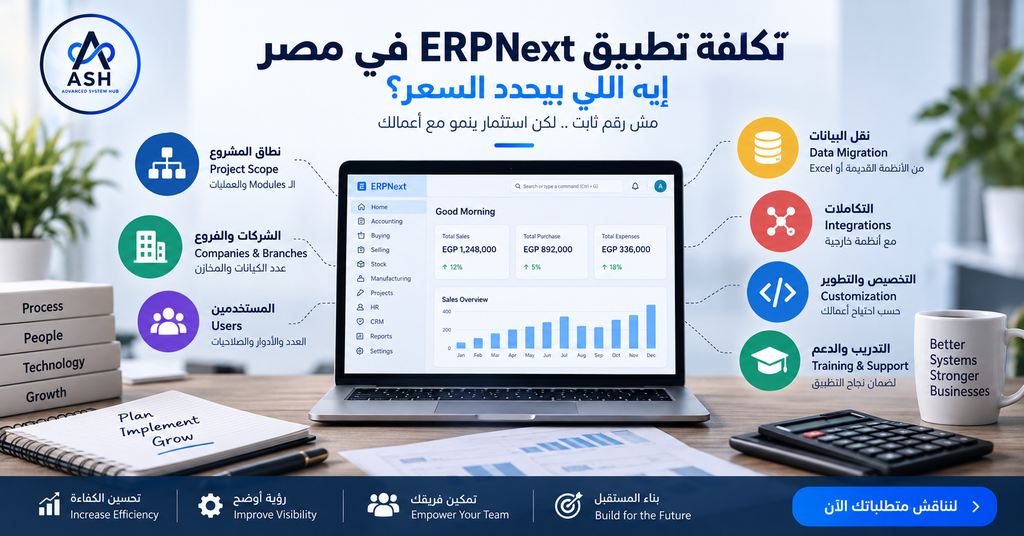
Does ERPNext Implementation Have a Fixed Price?
One of the first questions businesses ask when considering ERPNext is:
"How much will it cost?"
The short answer is: there is no single implementation price that fits every business.
ERPNext implementation cost depends primarily on the scope and complexity of the project.
A trading company using accounting, sales, purchasing, and inventory has very different requirements from a manufacturer managing production, BOMs (Bills of Materials), quality, multiple warehouses, and production planning.
A reliable estimate therefore starts with understanding the actual business requirements.
What Determines ERPNext Implementation Cost?
1. Project Scope
The number of processes and departments included in the implementation has a major impact on the required analysis, configuration, training, and testing.
An implementation covering Accounting, Selling, Buying, and Stock is different from a project that also includes Manufacturing, Quality, CRM (Customer Relationship Management), and HR (Human Resources).
2. Companies, Branches, and Warehouses
Multiple companies, branches, or warehouses can introduce additional requirements for permissions, accounting, reporting, and inventory movements.
The important factor is not simply how many locations exist, but how they interact operationally and financially.
3. Users and Roles
The number of users affects training, Roles, Permissions, and Workflow configuration.
However, 50 users following a similar process may sometimes be simpler to implement than 15 users operating across several highly complex processes.
User count matters, but it should never be the only basis for estimating an ERP project.
4. Standard ERPNext vs Customization
This is one of the most important cost factors.
At ASH Infinity, we follow a Standard-first approach: use standard ERPNext functionality whenever it correctly meets the business requirement.
When a genuine gap exists, the requirement may need additional configuration, a Workflow, Report, Customization, Integration, or Custom App.
Additional development requires analysis, implementation, and testing, which can affect both project cost and timeline.
5. Data Migration
Businesses moving from another ERP system or Excel usually need existing data migrated into ERPNext.
This may include:
- Customers
- Suppliers
- Items
- Opening Balances
- Stock Balances
- Fixed Assets
- Outstanding Invoices
Clean and structured data generally makes migration easier.
Duplicate, incomplete, or inconsistent data may require additional preparation and validation before it can be imported safely.
6. Integrations
Will ERPNext operate independently, or does it need to exchange information with other systems?
Examples include:
- E-commerce platforms
- Mobile applications
- External CRM systems
- Payment systems
- Shipping platforms
- Biometric devices
- Third-party APIs (Application Programming Interfaces)
Each integration should be assessed separately because complexity depends on the external system, available API, authentication method, and data exchanged.
7. Training and User Readiness
A successful ERP project is not simply software installation.
Users need to understand the new processes and know how to perform their daily work correctly in the system.
The number of departments, users, training sessions, and required hands-on training can therefore affect the overall implementation effort.
8. Post-Go-Live Support
After Go-Live, businesses may require a stabilization period, user assistance, issue investigation, and operational improvements.
The implementation scope should clearly define what is included in the project and what will be covered by a separate ongoing support arrangement.
ERPNext Cost vs Implementation Cost
It is important to distinguish between ERPNext as a software platform and the cost of implementing ERPNext within a business.
An implementation project may include business analysis, configuration, data migration, customization, integrations, user training, testing, Go-Live, and post-launch support.
There may also be operational costs such as hosting, infrastructure, and external services depending on the selected architecture.
For this reason, comparing ERP proposals using only one headline price can be misleading when their scopes are different.
How Can You Get a Realistic Estimate?
Before requesting a final quotation, prepare basic information about your business:
- Number of companies and branches
- Expected users
- Departments using ERPNext
- Required modules
- Current system
- Data that needs migration
- Required integrations
- Important business-specific requirements
A Discovery or Requirements Assessment can then define the scope more accurately.
Conclusion
ERPNext implementation cost in Egypt depends on the scope and complexity of the business requirements—not simply the number of users or the software itself.
Clear requirements lead to more accurate cost and timeline estimates and reduce unexpected changes during implementation.
At ASH Infinity, we start by understanding the business processes and use standard ERPNext functionality wherever possible before recommending customization.
If you want to estimate the scope and cost of ERPNext for your business, contact ASH Infinity to discuss your requirements.